
Air Quality of Fuvahmulah
60
AQI
GoodHazardous
421 ppm
Carbon dioxide
84%
Humidity
10 hPa
Pressure
Recommendations
Sensitive groups should reduce long outdoor exercise
Ventilate indoors during cleaner parts of the day
Consider a mask if you feel irritation
Optional use of air purifier
Particulate Matter (PM)
Air Quality for Past 24 Hours
Air Quality for Past 7 Days
Frequently Asked Questions What is Air Quality Index (AQI)?
What is U.S. AQI Scale?
What is the purpose of U.S. AQI?
How is the U.S. AQI measured?
How is the U.S. AQI changing?
What is Air Quality Index (AQI)?
AQI is a system that reports the quality of air. The information shown in this page is measured in U.S AQI. The U.S. AQI is an air quality tool developed by the United States Environmental Protection Agency (EPA) to communicate to the public health risk due to outdoor air pollution. Its goal is to simplify and distil complicated air quality data into useful, easy to understand information regarding the health risks pose by current or future air quality conditions. While globally there are over 30 different AQIs, the U.S. AQI is widely recognised the most influential. The U.S. implemented the world's first air quality index in 1976 to draw public attention to the issue of air pollution.
What is U.S. AQI Scale?
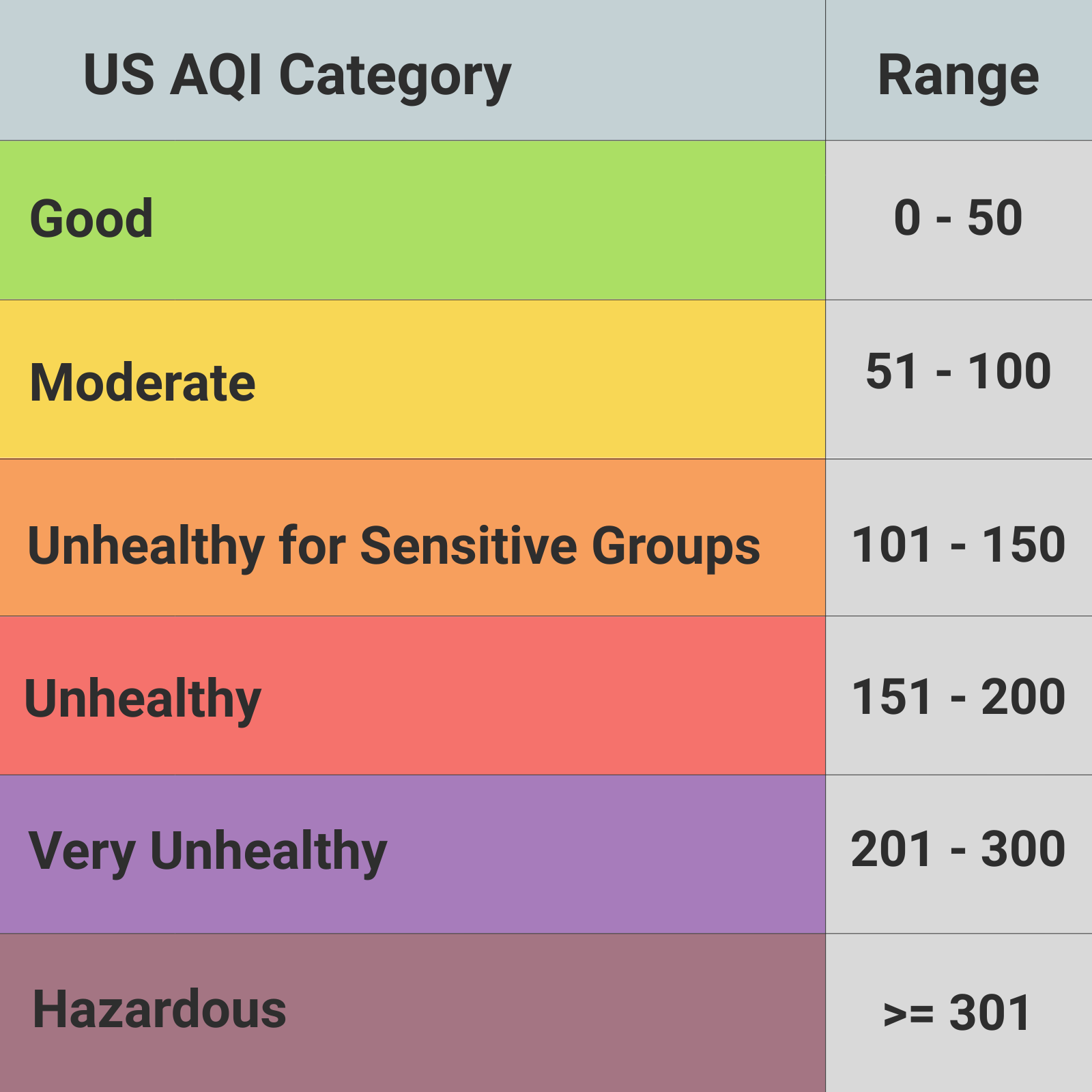
The US AQI Scale is between 0 and 500, and is classified into six colour-coded categories (Good, Moderate, Unhealthy for Sensitive Groups, Unhealthy, Very Unhealthy, Hazardous) which are each associated with different health risk warnings.
What is the purpose of U.S. AQI?
The purpose of the U.S. AQI is to quantify the level of air pollution at a certain location from different measured concentrations of air pollutants
How is the U.S. AQI measured?
The U.S. AQI is calculated by measuring concentrations of up to six pollutants, that are referred to as criteria pollutants, consisting of fine particulate matter (PM2.5), coarse particulate matter (PM10), ozone (O3), nitrogen dioxide (NO2), sulfur dioxide (SO2) and carbon monoxide (CO) at a specific location. Each pollutant's concentration is converted into an index number; the highest of these determines the AQI at this location. The pollutant with the highest number is termed the dominant pollutant. In most places and at most times, the dominant pollutant is PM2.5, fine particles of up to 2.5 microns diameter. These particles can penetrate deep into our lungs or bloodstream and pose health risks. They include particles from smoke and soot in addition to fine dust.
How is the U.S. AQI changing?
On 6th May 2024, the U.S. Environmental Protection Agency (EPA) implemented an update to the United States Air Quality Index (U.S. AQI), the EPA's colour-coded tool for communicating air quality to the public. The new U.S. AQI lowers the concentration threshold at which fine particulate matter (PM2.5) is considered good from 12 μg/m3 to 9 μg/m3 and lowers the PM2.5 thresholds, often referred to as breakpoints, for the Very Unhealthy and Hazardous categories. The EPA decision acknowledges new research indicating health risks even at low PM2.5 levels. As a consequence of this change, U.S. AQI values and the associated colours could in more instances go from predominantly green values to more yellow values.